
Most candidates prepare for the FRCEM SBA the same way they prepared for medical school exams — read broadly, hope for coverage, and revise everything roughly equally. That approach doesn't work here. The FRCEM SBA isn't a random sample of emergency medicine knowledge. It's a tightly blueprinted exam, meaning every question is deliberately mapped to a specific Specialty Learning Outcome (SLO) from the RCEM 2021 curriculum, with a fixed number of marks allocated to each one.
If you don't know what the blueprint actually looks like, you're revising blind. You might spend three weeks perfecting toxicology while SLO3 — resuscitation — quietly carries more marks than any other single domain. Understanding the blueprint is the single most important strategic decision you'll make in your preparation.
What Is the FRCEM SBA Exam? A Short Recap
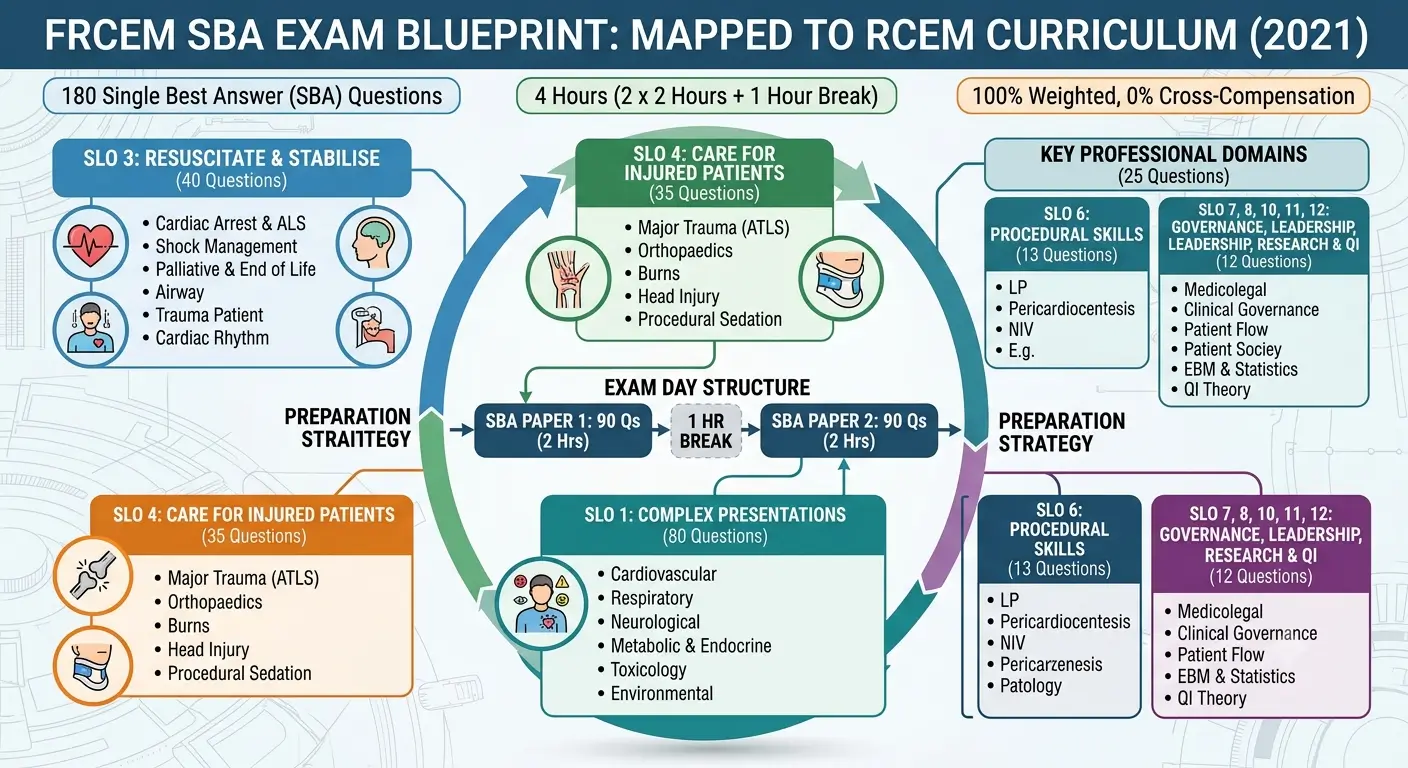
180 single-best-answer (SBA) questions, split across two papers of 90 questions each
Two hours per paper, with a one-hour break in between — four hours of total exam time
Machine-marked: one mark for a correct answer, zero for incorrect, with no negative marking
Pass mark set using a modified Angoff method, with one standard error of measurement added — so it shifts each sitting slightly
2026 update: the curriculum and blueprint themselves haven't changed—the RCEM 2021 Emergency Medicine Curriculum remains the active document. What has changed is delivery: from January 2026, RCEM theory exams, including the FRCEM SBA, moved from Pearson VUE to Surpass Assessment. Candidates still apply through their RCEM account but now book their test centre through Surpass, with a global network of centres across the UK and countries including Ireland, India, Pakistan, the UAE, Saudi Arabia, and Egypt.
Understanding the RCEM 2021 Curriculum and SLOs
The RCEM 2021 curriculum organises emergency medicine training around Specialty Learning Outcomes, or SLOs. Each SLO represents a broad capability a consultant-level emergency physician must demonstrate — not just "know," but apply under pressure, in context, with judgement.
One key structural change came with this curriculum: the old standalone Critical Appraisal and Quality Improvement Project (QIP) components were withdrawn as separate examinations. Their competencies weren't removed — they were folded into the SBA and OSCE instead. This is exactly why research, statistics, and quality improvement now appear as SBA questions, a detail a surprising number of candidates overlook when assuming those topics don't apply to them.
Every SBA question sits under one specific SLO, and the exam doesn't sample the curriculum evenly.
The Full FRCEM SBA Blueprint: SLO-by-SLO Breakdown
Based on the published RCEM blueprint, here's roughly how the 180 marks are distributed. Exact question counts can shift slightly sitting to sitting, so cross-check against the current RCEM Regulations and Information Pack:
SLO1 – Stable patients across the full range of complexity (~35 questions): general medical and surgical ED presentations
SLO3 – Resuscitation, excluding major trauma (~40 questions): the single highest-weighted SLO, covering ALS, sepsis, DKA, and other time-critical physiology
SLO4 – Injured patients across the full range of complexity (~35 questions): trauma management, minor to major
SLO5 – Paediatric emergency medicine (~30 questions): all ages and complexity, including safeguarding
SLO6 – Procedural skills (~13 questions): practical competencies in theoretical format
SLO7 – Medicolegal and complex situations (~10 questions): capacity, consent, safeguarding
SLO8 – ED leadership (~7 questions): departmental flow, major incident response
SLO10, 11, 12 – Research, statistics, QI, and education (~20 questions combined): often under-revised relative to their yield
Together, SLO3, SLO1, SLO4, and SLO5 account for well over half the total marks.
Which SLOs Should Drive Your Revision Priority
If you take one point from this article, take this: resuscitation and stable-patient presentations aren't optional revision areas — they're where the exam lives.
A common mistake is treating every SLO as equally important because every SLO technically counts. In practice, splitting time evenly between SLO8 (7 questions) and SLO3 (40 questions) wastes limited revision hours.
Prioritise SLO3, SLO1, SLO4, and SLO5 first — together over 70% of the paper
Treat SLO6 and SLO7 as important but secondary
Don't skip SLO8 and SLO10–12 entirely — they're low-volume but high-yield in a different way
The Overlooked SLOs Where Candidates Lose Easy Marks
SLOs 10, 11, and 12 carry relatively few marks, but the concepts tested are narrow and predictable — basic study design, sensitivity versus specificity, PDSA cycles. Many candidates, intimidated by "statistics," skip this section entirely and gamble on guessing. That's a mistake: a few focused hours here can lock in marks that are often easier to secure than a tricky SLO3 stem.
Turning the Blueprint Into an Actual Revision Plan
Map revision materials to SLOs, not textbook chapters — a "cardiology" chapter might span SLO1, SLO3, and SLO7 at once
Allocate time proportionally, weighting toward SLO3, SLO1, SLO4, and SLO5
Use an SLO-tagged question bank so you always know which curriculum point is being tested
Track performance by SLO, not just overall score — a 70% average can hide a 40% weak spot in a high-yield SLO
Revisit SLO10–12 in short, dedicated sessions rather than skipping them
Common Blueprint Mistakes to Avoid
Studying by clinical topic instead of by SLO, making true coverage hard to judge
Assuming low-question SLOs aren't worth revising
Using question banks that don't tag questions to SLOs
Relying on outdated guideline-based questions when the exam tests current UK practice
How StudyFRCEM Aligns With This Blueprint
This is exactly the structure StudyFRCEM's question bank is built around. Every question in our 1,800+ bank is tagged to the exact SLO it tests, so you know precisely what you're revising and why. Combined with performance analytics broken down by SLO, you can see at a glance where your weak spots sit relative to the actual exam weighting.
Conclusion
The FRCEM SBA rewards candidates who revise strategically, not extensively. Once you know exactly where the 180 marks sit across the RCEM SLOs — and understand the 2026 shift to Surpass Assessment for booking — your preparation becomes a targeted plan built around the exam's actual priorities, not guesswork.
Ready to revise against the real blueprint? Try StudyFRCEM's free demo to see SLO-mapped questions and consultant-level explanations built around exactly this framework.
Frequently Asked Questions
Has the FRCEM SBA blueprint changed for 2026?
No — the RCEM 2021 curriculum and blueprint remain active for 2026. The main change is logistical: theory exams are now delivered via Surpass Assessment instead of Pearson VUE.
How many SLOs are tested in the FRCEM SBA?
The exam samples across the full RCEM 2021 curriculum, but SLO3, SLO1, SLO4, and SLO5 carry the bulk of the 180 marks.
Should I revise SLO8 and SLO10–12 if they carry so few marks?
Yes — the concepts tested tend to be narrow and predictable, making them relatively easy marks with minimal revision time.
What's the difference between the MRCEM and FRCEM blueprints?
MRCEM SBA covers SLO1 and SLOs 3–7 at registrar level, while FRCEM SBA tests the same SLO framework at consultant-level depth.
How do I know which SLO a practice question is testing?
Not all question banks tell you this. Look for a bank that explicitly tags each question to its RCEM SLO, so you can track performance against the real exam weighting.